The language of seals
Buying a ham can be an overwhelming experience. You arrive at the store (or browse our website at Jamonarium) and see different colored tags: black, red, green, white… They’re not just for show. These Iberian ham tags are the ham’s ID and are regulated by the Iberian Quality Standard (Royal Decree 4/2014).
Understanding this color code is the only way to ensure that what you’re paying for matches reality. In this guide, we explain how to read these labels so you can shop like a true expert.
1. The importance of the Quality Standard
Before 2014, the labeling was confusing. Today, thanks to ASICI (Interprofessional Association of Iberian Pork), each ham has a tamper-evident seal around the shank. If a ham is sold as «Iberian» but doesn’t have one of these four seals, be suspicious.
The seals tell us about two key factors:
- The breed: Whether the pig is 100% Iberian or if it is crossbred (75% or 50%).
- Feeding: What the animal has eaten and where it has been raised (pasture or farm).
2. The Color Code: The 4 official seals
🖤 Black Seal: Pata Negra (Excellence)
It’s the king of hams. When you see a black label, you’re looking at a 100% Iberian acorn-fed ham .
- Breed: Parents 100% Iberian registered in the genealogical book.
- Feeding: It has lived freely in the pasture and has fattened exclusively on acorns and natural grasses during the montanera.
- Flavor: It is the most intense, with the highest amount of oleic acid. It is the only one that can legally be called «Pata Negra».
❤️ Red Seal: Iberian Acorn-fed
Pay attention here, because the diet is the same as for black people, but the breed varies.
- Breed: They are pigs that are 75% or 50% Iberian breed (generally 100% Iberian mother and Duroc breed father).
- Diet: Free-range acorns.
- Flavor: Due to its cross with Duroc, the fat marbling is usually more visible (more pronounced white streaks), which makes it very juicy and appreciated by many palates.
💚 Green Seal: Iberian Cebo Campo
This is high-quality «medium» ham.
- Breed: Can be 100%, 75% or 50% Iberian.
- Feeding: Although they eat feed, they roam freely in fields or open pastures. Because they exercise, the quality of their meat is superior to that of standard feedlot cattle.
- Use: Ideal for those looking for Iberian flavor at a more affordable price for everyday consumption.
🤍 White Seal: Iberian Cebo
The most economical option within the Iberian world.
- Breed: Same as the green one (100%, 75% or 50% Iberian).
- Feeding: Raised on farms with compound feeds made from cereals and legumes.
- Flavor: Milder and less complex than previous ones, but maintaining the genetics of the breed.
3. How to read the commercial label?
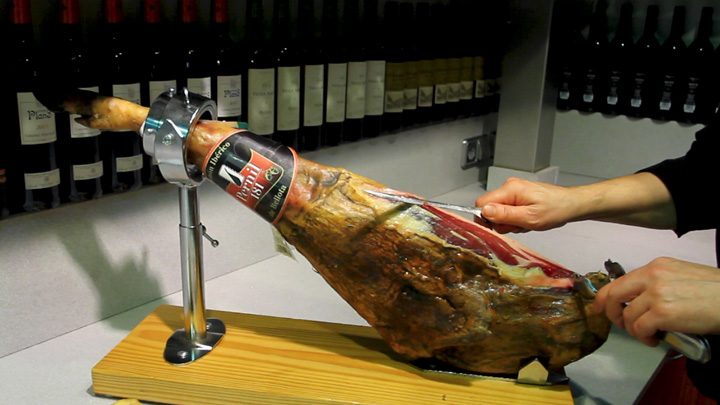
In addition to the seal (the plastic tie), there’s the manufacturer’s label. At Jamonarium, we’re transparent: make sure the percentage of Iberian breed is always listed. If it simply says «Jamón Ibérico,» the percentage must be specified right below it.
A pro tip: Look for the Protected Designation of Origin (PDO) seal (such as Jabugo, Guijuelo, Dehesa de Extremadura, or Los Pedroches). These seals add an extra layer of control and quality over standard seals.
4. Common myths about labels
- «If the hoof is black, it’s an acorn-fed pig»: False. There are white pigs with dark hooves and Iberian pigs with light hooves. Always look at the color of the tag , not the color of the hoof.
- «The red tag is better than the black one»: It’s not better or worse, it’s different. Black represents purebred cattle; red usually has more marbling due to the Duroc crossbreeding. It’s a matter of taste.
Your choice at Jamonarium
Now that you know the meaning of the Iberian ham labels , you can choose wisely. In our online store, each product is clearly identified by its seal color so there are no surprises.
Are you looking for the purity of black or the juiciness of red? Whatever your choice, at Jamonarium we guarantee that every ham tells a true story of quality.
 Español
 Català
  English
 Français
 Deutsch
 Italiano
 Dutch
Dutch