The gourmet’s big question
You’re on Jamonarium.com, determined to treat yourself or find the perfect gift. You know you want Iberian quality, perhaps a 100% Bellota or a Cebo de Campo. But then the million-dollar question arises: Should I buy a ham or a shoulder ?
At first glance, both are cured pork legs, but they represent very different culinary and economic experiences. The price difference is obvious, but what accounts for it? Is it a matter of quality or quantity? In this guide, we explain, without unnecessary technical jargon, everything you need to know to decide which leg is right for you. Spoiler alert : neither is better than the other; it all depends on who you are and how you plan to eat it.
1. A Matter of Anatomy and Weight
The first difference is physical and obvious.
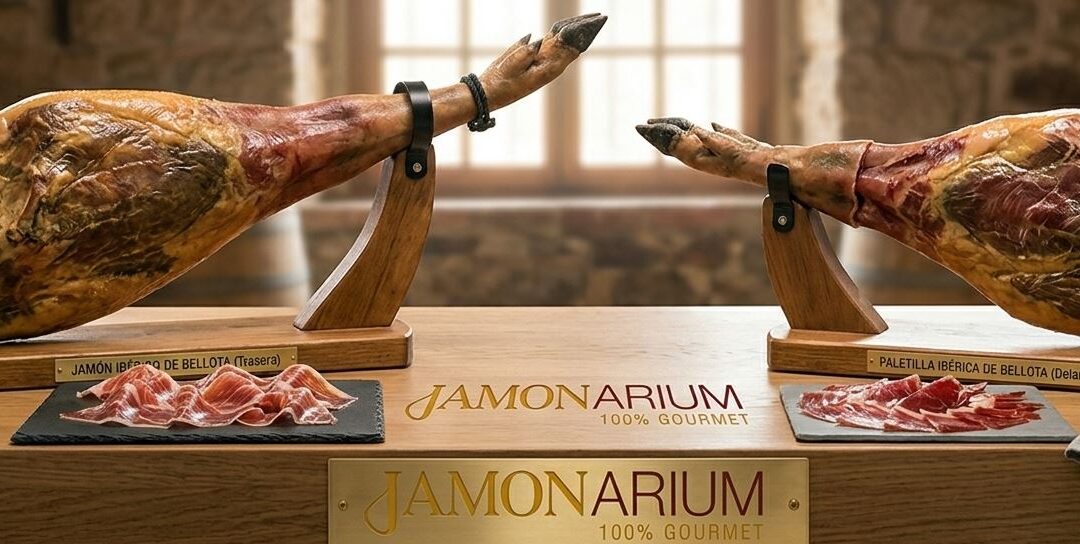
- The Ham: It is the hind leg of the pig. It is larger, longer and more rounded . Its weight usually ranges between 7 and 9 kg (in the case of Iberian ham).
- The shoulder (or paleta): This is the front leg. It is smaller, shorter, and more slender . Its weight ranges between 4 and 6 kg.
SEO key: This weight difference directly influences the yield of the piece (the amount of edible meat you extract).
2. Yield: How much meat am I actually buying?
This is where many customers are surprised. The shoulder ham has proportionally more bone and more external fat than the leg ham.
- Ham Yield: Approximately 50% of the total weight is edible meat. From an 8 kg piece, you get about 4 kg of slices.
- Shoulder yield: Approximately 40% of the total weight is edible meat. From a 5 kg piece, you get about 2 kg of slices.
Conclusion: Although shoulder ham is cheaper per kilo gross weight , if you calculate the price per kilo of net meat , the difference is considerably reduced. At Jamonarium, we always advise you on this to avoid any misunderstandings.
3. Flavor, Texture and Curing: The organoleptic factor
Here we enter the realm of personal tastes.
- The shoulder: Intensity and Speed. Being smaller and having more bone, the fat is closer to the meat. This, combined with a shorter curing process (between 18 and 24 months for acorn-fed Iberian ham), results in a more intense, powerful flavor, and sometimes a touch saltier. The texture is firmer.
- Ham: Complexity and Elegance. With its greater muscle mass and intramuscular fat, it requires a much longer curing process (between 36 and 48 months for acorn-fed ham ). This allows the aromas to develop more slowly, resulting in a more complex, smooth, sweet, and nuanced flavor. The texture is also more unctuous due to the increased marbling.
4. Ease of Cutting: A Challenge for Beginners
If you’re going to cut the piece at home, this will be of great interest to you.
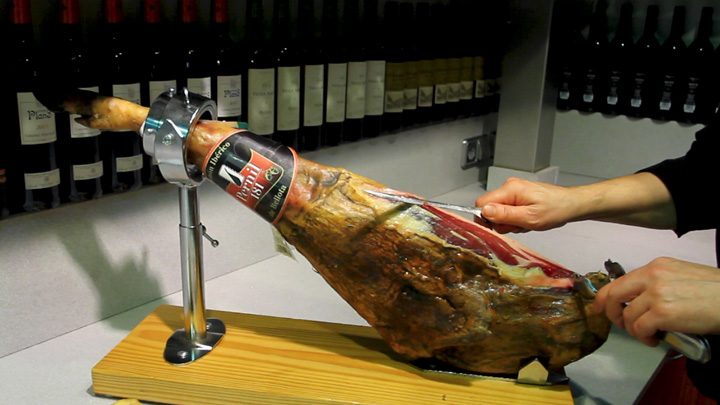
- The Ham: Its shape is flatter and more regular. The bones are easier for the inexperienced carver to «dodge.» It’s the recommended option if you’re starting out in the art of carving.
- The shoulder blade: It is more angular and has a problematic bone: the scapula (the «shoulder blade» itself), which is S-shaped. Cutting uniform slices in the shank area of a shoulder blade requires more technique and patience.
5. Comparative Summary: Which one to choose?
| Feature | Ham (Hind Leg) | Shoulder (Front Leg) |
| Average Weight | 7 – 9 kg | 4 – 6 kg |
| Healing Time | Longer (36-48 months) | Shorter (18-24 months) |
| Meat Yield | Greater (~50%) | Lower (~40%) |
| Flavor | Complex, Smooth, Elegant | Intense, Powerful, Direct |
| Ease of Cutting | High (Ideal for beginners) | Medium-Low (Requires technique) |
| Price per Piece | Elderly | Minor |
6. The Final Decision: Practical Situations
Buy the shoulder ham if…
- There are only a few of you at home (1-2 people): Since it’s smaller, you’ll finish it before it dries out. A shoulder of ham that’s been started should be eaten within 15-20 days.
- You’re looking for an intense flavor: You prefer the power of the direct Iberian flavor over the complexity of nuances.
- You have a tight budget: You want high-quality acorn-fed Iberian ham , but the total price of a ham is beyond your budget.
- You already know how to cut: Or do you fancy the challenge of dealing with the bones of the front leg.
Buy the ham if…
- Are you a family or expecting visitors? An 8 kg ham goes a long way and keeps well for about 30 days once opened if stored properly (see our Month 5 post).
- You seek gastronomic excellence: You want to experience the complexity of aromas and the unctuous texture that only the long years of curing of acorn-fed Iberian ham can offer.
- It’s a significant gift: A whole ham makes a bigger impression and is a sure hit for a celebration.
- You don’t want complications when cutting: You prefer a piece that’s easier to handle with a ham knife.
Jamonarium quality on both legs
At Jamonarium , all our 100% Iberian acorn-fed, grain-fed, and free-range shoulder hams and shoulders undergo the same rigorous quality controls. The difference lies not in the quality of the raw material, but in the morphology of the leg and the curing times it requires.
Whether you choose ham or shoulder , if it’s Jamonarium, you’re choosing authenticity. Enjoy the experience!
 Español
 Català
  English
 Français
 Deutsch
 Italiano
 Dutch
Dutch